
About | Publications
OntoMat 4.0: Revolutionizing Industry 4.0 Adoption
This research addresses significant challenges faced by organizations, particularly those in developing countries and Small and Medium-sized Enterprises (SMEs), when trying to adopt Industry 4.0 (I4.0). While I4.0 maturity models (I4.0 MMs) are designed to assess readiness, they suffer from several issues:
• Limited Applicability: Most existing I4.0 MMs were developed for advanced economies, making them less effective in developing countries with unique constraints like limited resources, infrastructure, and technical expertise.
• Lack of Standardization: There’s no universally accepted standard for I4.0 MMs, leading to fragmented frameworks, inconsistent metrics, and difficulties in comparing performance across companies or industries.
• Narrow Focus: Many models focus primarily on technical aspects of I4.0, often overlooking crucial organizational and cultural factors like workforce skills, leadership, and willingness to change, which are essential for holistic transformation.
• Rapid Obsolescence: The fast pace of I4.0 technological advancements means models quickly become outdated if not continuously updated and adaptable.
• Interoperability Issues: Older systems struggle to integrate with new I4.0 technologies, causing compatibility and interoperability problems.
To bridge these gaps, Angreani’s research proposes an adaptable I4.0 maturity model and introduces a key innovation: OntoMat 4.0.
——————————————————————————–
How OntoMat 4.0 and the Hybrid Approach Transform I4.0 Adoption:
This research presents a comprehensive, integrated approach built on several pillars:
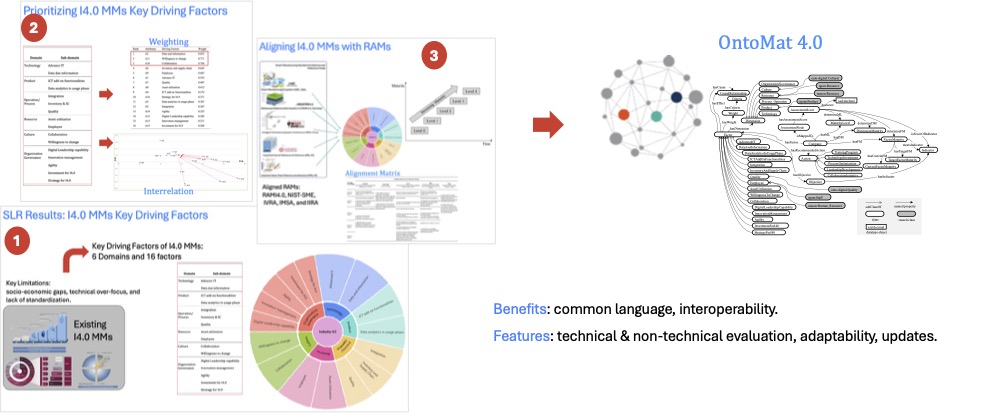
1. Systematic Review and Gap Identification:
◦ The research began with extensive structured literature reviews (SLRs) of over 80 I4.0 MMs, identifying their limitations, scope variations, and the critical need for models suitable for diverse regional and organizational contexts.
◦ This review helped establish a foundation for developing more practical and effective I4.0 MMs.
2. Prioritizing Driving Factors with Multi-Criteria Decision-Making (MCDM):
◦ Using advanced MCDM tools like Fuzzy TOPSIS and Fuzzy DEMATEL, the study identified and prioritized key factors influencing I4.0 adoption. These factors span technological, organizational, and cultural aspects (e.g., technological readiness, workforce skills, organizational culture, strategic alignment).
◦ Fuzzy DEMATEL specifically helped to map the interdependencies among these factors, revealing that “Strategy for I4.0” is often central and significantly influences other areas like employee readiness and innovation management. This provides actionable guidance for resource allocation.
3. Strategic Alignment with Reference Architecture Models (RAMs):
◦ The research aligns I4.0 MM factors with reputable standard reference architecture models (RAMs) such as RAMI 4.0 and NIST-SME.
◦ This alignment helps bridge the gap between theoretical models and practical implementation by offering a clear roadmap for organizations to integrate their strategic and operational goals. This is particularly beneficial for SMEs and organizations in developing countries, allowing for staged, systematic I4.0 adoption with clear milestones.
4. OntoMat 4.0: A Standardized Ontology Framework:
◦ OntoMat 4.0 is a novel ontology developed to provide a structured, graph-based representation of I4.0 knowledge, addressing the lack of standardization and enhancing interoperability.
◦ It offers a framework that considers a balanced approach of technical and non-technical elements, including organizational and cultural factors vital for a holistic I4.0 transformation.
◦ OntoMat 4.0 is designed to be modular, extensible, and compatible with other relevant ontologies (e.g., RGOM, MASON, Onto-Digital), supporting continuous updates and knowledge exchange across sectors.
——————————————————————————–
Key Benefits and Impact of this Research:
• Adaptability for Diverse Contexts: The framework ensures I4.0 MMs are relevant and effective for developing countries and SMEs, considering their unique socio-economic and infrastructural conditions.
• Enhanced Strategic Planning: Provides clear insights into which factors to prioritize and how they interrelate, enabling better-informed decisions for I4.0 implementation and resource allocation.
• Improved Transparency and Comparability: OntoMat 4.0 facilitates a common language for I4.0 maturity assessment, allowing for consistent evaluations and benchmarking across organizations and industries.
• Holistic Transformation: Goes beyond purely technical aspects to integrate human, cultural, and organizational readiness into the assessment, promoting sustainable I4.0 adoption.
• Actionable Insights for Policymakers: The identified driving factors and interdependencies provide valuable orientation for public policy initiatives, focusing on impactful areas like workforce development and infrastructure investment for national I4.0 strategies.
——————————————————————————–
Future Directions and Limitations:
The research acknowledges its limitations and proposes future work, including:
• Integrating sustainability metrics into OntoMat 4.0 to align I4.0 adoption with global environmental and social goals.
• Investigating the “Customer” factor, which is increasingly influencing digital strategies and technical investments.
• Exploring the integration of Artificial Intelligence (AI) and machine learning into OntoMat 4.0 for real-time assessments and adaptive recommendations.
• Conducting longitudinal studies to track the long-term effectiveness of OntoMat 4.0.
• Expanding OntoMat 4.0 into a collaborative ecosystem to foster cross-industry knowledge sharing and best practices.
Overall, this research provides a robust foundation for improving I4.0 maturity assessments, offering practical tools and strategic insights to support organizations in achieving sustainable digital transformation, especially in challenging environments.
Publications
Systematic Literature Review of Industry 4.0 Maturity Model for Manufacturing and Logistics Sectors
https://doi.org/10.1016/j.promfg.2020.11.056
Identifying Essential Driving Factors of Industry 4.0 Maturity Models Using Fuzzy MCDM Methods
https://doi.org/10.1016/j.procir.2023.09.217
Evaluating the Interrelationships of Driving Factors of Industry 4.0 Maturity Models in Developing Countries using Fuzzy DEMATEL
https://doi.org/10.1109/IEEM58616.2023.10406637
Interdependencies of Industry 4.0 Maturity: Fuzzy MCDA Analysis for Open Innovation in Developing Countries
https://doi.org/10.1016/J.JOITMC.2024.100382
Enhancing Strategy for Industry 4.0 Implementation through Maturity Models and Standard Reference Architectures Alignment
https://doi.org/10.1108/JMTM-07-2022-0269
OntoMat 4.0: An Ontology Framework for Enhanced Industry 4.0 Maturity Assessment
https://doi.org/10.1109/ACCESS.2025.3561229