
About | Publications
Revolutionizing ESG Reporting: Introducing the ESGOnt Hybrid Framework
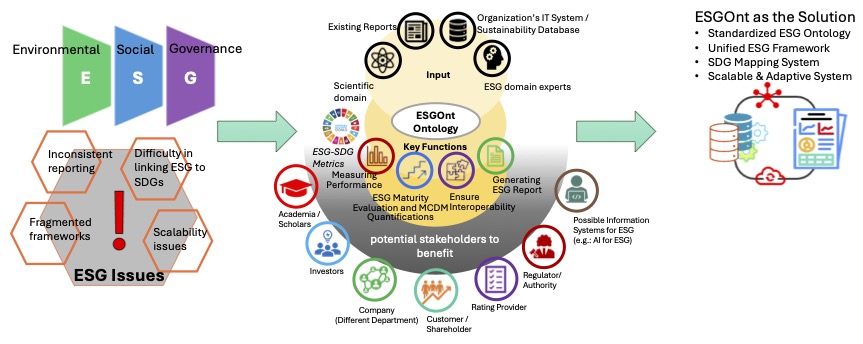
Environmental, Social, and Governance (ESG) reporting is increasingly vital for corporate transparency and accountability, yet it faces persistent and significant challenges. Companies, investors, and regulators grapple with a complex landscape marked by:
• Fragmented Standards & Inconsistent Metrics: Numerous ESG reporting frameworks (such as GRI, SASB, TCFD, ESRS) exist independently, leading to varying definitions, inconsistent metrics, and difficulties in comparing performance across companies and industries.
• Data Fragmentation: ESG information is scattered across diverse sources like legacy databases, spreadsheets, and unstructured documents (e.g., PDFs), making it challenging to integrate into a cohesive, reliable dataset.
• Weak Alignment with Global Goals: There’s often a limited and inconsistent connection between corporate ESG reporting and global sustainability targets, especially the UN Sustainable Development Goals (SDGs), making it hard to measure genuine impact.
• Limited Stakeholder Usability: Current ESG reports are often technical and data-heavy, making them difficult for non-specialist stakeholders (like investors or the public) to understand and use for informed decision-making.
• Risk of Greenwashing: These issues weaken data reliability, benchmarking, and decision-making, increasing the risk of companies presenting a misleadingly positive image of their sustainability efforts.
This research proposes an innovative solution: ESGOnt, a novel, integrated framework designed to address these critical gaps. ESGOnt is a hybrid framework that leverages semantic technologies, multi-criteria decision-making (MCDM) methods, and ESG maturity models.
——————————————————————————–
How ESGOnt Transforms ESG Reporting:
ESGOnt’s power lies in its integrated approach, combining three core technological pillars:
1. Semantic Modeling (Ontology-Driven Data Management):
◦ Standardized Terminology: ESGOnt develops a modular ESG ontology to create a uniform, graph-based semantic model of ESG concepts. This standardizes terminology and metrics across diverse reporting frameworks (e.g., GRI, SASB, TCFD, ESRS) using explicit mappings, fostering a shared understanding of data and models.
◦ Integrated Data Sources: It acts as a universal framework for fusing data from various sources—structured databases, spreadsheets, and unstructured reports—by establishing defined concepts and standardized terminology for mapping. This enables the creation of knowledge graphs that organize interconnected ESG information, allowing stakeholders to discover previously hidden patterns.
◦ Gap Identification & Reasoning: The ontology can explicitly identify overlaps and missing elements between reporting standards, and through reasoning functions, it can determine which standards are applicable to specific products or organizations.
2. Quantitative Assessment (Multi-Criteria Decision-Making – MCDM):
◦ ESGOnt integrates robust MCDM techniques, including Analytic Hierarchy Process (AHP), Fuzzy DEMATEL, and Fuzzy TOPSIS.
◦ These methods are used to quantitatively evaluate ESG performance, prioritize areas for improvement, and analyze the complex interrelationships between various ESG factors.
◦ The use of Fuzzy Logic specifically helps to handle the inherent uncertainties in expert judgments and complex ESG data, producing more robust and interpretable results. Fuzzy DEMATEL, for example, identifies cause-and-effect relationships among KPIs, while Fuzzy TOPSIS ranks them based on their closeness to ideal solutions.
3. Strategic Improvement (ESG Maturity Models):
◦ An ESG maturity model is incorporated to provide a structured approach for organizations to assess their current level of ESG practice adoption and identify operational gaps.
◦ This model guides strategic improvement planning and produces quantifiable results comparable to standard ESG rating systems, allowing organizations to track their progress and benchmark against peers. ESGOnt’s model covers five distinct levels, from “Nonexistent” to “Optimized,” charting a clear path for ESG evolution.
——————————————————————————–
Key Benefits and Impact of ESGOnt:
• Enhanced Transparency & Accountability: ESGOnt transforms complex ESG information into easily understandable metrics and visualizations, significantly improving data interoperability, comparability, and transparency for all stakeholders. This transparent linkage between metrics and performance indicators also reduces the risk of greenwashing.
• Direct Alignment with Global Goals: The framework explicitly maps corporate ESG metrics to the UN SDGs, ensuring that company sustainability efforts contribute meaningfully and measurably to international targets.
• Improved Decision-Making & Strategic Planning: By providing robust quantitative assessments and actionable insights, ESGOnt supports better-informed decisions for companies, investors, and policymakers, enabling more effective strategic planning and resource allocation.
• Scalability & Adaptability: Designed with modularity and extensibility, ESGOnt can accommodate evolving standards, new data types, and varying industry requirements, making it adaptable to a dynamic ESG landscape.
• Practical Application: Validated through real-world use cases, ESGOnt demonstrates its capacity to integrate ESG assessments with SDGs, evaluate organizational development, and verify compliance for both Small and Medium Enterprises (SMEs) and multinational corporations.
• Operational Efficiency: It offers a systematic method for ESG data collection, organization, and reporting, which can streamline compliance processes and improve operational efficiency for businesses.
——————————————————————————–
This research significantly advances the understanding of how semantic models can be effectively combined with quantitative methods to create robust, transparent, and actionable sustainability reporting systems. By doing so, ESGOnt aims to strengthen corporate accountability and drive more effective contributions to global sustainable development, transforming ESG reporting from a fragmented compliance exercise into an impactful tool for driving positive change.
Publications
Advancing Sustainability in the Automotive Sector: A Critica Analysis of Environmental, Social, and Governance (ESG) Performance Indicators
https://doi.org/10.1016/j.cesys.2024.100248
Rating ESG key performance indicators in the airline industry
https://doi.org/10.1007/s10668-023-03775-z
ESGOnt: An Ontology-Based Framework for Enhancing Environmental, Social, and Governance (ESG) Assessments and Aligning with Sustainable Development Goals (SDG)
https://doi.org/10.1016/j.resenv.2025.100262
From Fragmentation to Interoperability: How Semantic Models Transform Environmental, Social, Governance (ESG) Reporting and Sustainability Governance
(coming soon)